
Search engine marketing (SEM) is a digital advertising strategy that places your business at the top of search engine results pages through paid advertisements, allowing you to reach potential customers at the exact moment they’re searching for your products or services.
For business owners in legal practices, healthcare facilities, franchises, and restaurants, SEM represents one of the most direct pathways to capturing high-intent prospects. Unlike organic marketing efforts that can take months to generate results, SEM delivers immediate visibility. When someone searches for “personal injury lawyer near me” or “Italian restaurant downtown,” your paid ad can appear above all other results, putting your business front and center before competitors.
The data speaks clearly: businesses earn an average of $2 in revenue for every $1 spent on Google Ads, according to industry benchmarks. But that return depends entirely on strategic execution. Many business owners mistakenly believe SEM simply means “buying ads on Google.” The reality involves sophisticated targeting, bid management, keyword selection, ad copywriting, and continuous optimization based on performance metrics.
This article breaks down exactly what SEM entails, how the auction-based system works behind the scenes, the different components that make up a successful campaign, and practical applications for your specific industry. You’ll gain the foundational knowledge needed to evaluate whether SEM fits your marketing goals and budget, plus insights into what separates profitable campaigns from wasteful spending.
What Is Search Engine Marketing?
Search engine marketing is a paid digital advertising strategy that places your business at the top of search engine results pages when potential customers search for products or services you offer. Unlike organic search engine optimization, which can take months to build momentum, SEM delivers immediate visibility by allowing businesses to bid on keywords and display targeted ads to users actively searching for what they provide.
At its core, SEM operates on a pay-per-click model: you only pay when someone clicks your ad. This makes it one of the most measurable and accountable marketing channels available, since you can track exactly how much you spend and what you get in return. When a user enters a search query, an automated auction determines which ads appear based on bid amounts, ad quality, and relevance to the search.
The concept emerged in the early 2000s when Google launched AdWords (now Google Ads), transforming how businesses connect with customers online. What started as simple text ads has evolved into a sophisticated ecosystem that includes shopping ads with product images, local service ads with ratings, and remarketing that follows users across the web. Today’s SEM platforms use machine learning and automation to optimize campaigns in real time, adjusting bids and targeting based on performance data.
Understanding the fundamental terminology helps clarify how SEM functions:
- PPC (Pay-Per-Click)
- The billing model where advertisers pay only when users click their ads, making costs directly tied to engagement.
- SERP (Search Engine Results Page)
- The page users see after entering a search query, where both paid ads and organic results appear.
- Ad Rank
- The formula search engines use to determine ad position, combining bid amount with quality score.
- Quality Score
- A metric rating ad relevance, landing page experience, and expected click-through rate, affecting both ad placement and cost per click.
Within the broader digital marketing landscape, SEM fills a distinct role. While SEO builds long-term organic presence and social media nurtures relationships, SEM captures demand that already exists. It targets people who are actively looking for solutions right now, making it particularly valuable for businesses that need consistent lead generation or want to test new markets quickly without waiting for organic rankings to develop.

How Search Engine Marketing Works
The Ad Auction Process
Every time a user enters a search query, search engines run an instant auction to determine which ads appear and in what order. This process happens in milliseconds, evaluating every eligible advertiser competing for that particular search term.
The auction begins when someone searches. Search engines assess all advertisers bidding on keywords that match or relate to the query. However, the highest bidder doesn’t automatically win the top position. Instead, search engines calculate Ad Rank in auctions by multiplying your maximum bid by your Quality Score, a metric that evaluates the relevance and usefulness of your ad and landing page.
Quality Score considers three primary factors: expected click-through rate (how likely users are to click your ad), ad relevance (how closely your ad matches the search intent), and landing page experience (whether your destination page delivers what the ad promises). An advertiser with a lower bid but higher Quality Score can outrank a competitor who bids more but offers a less relevant experience.
This system rewards advertisers who create better user experiences. A law firm with highly relevant ad copy and a focused landing page can achieve prominent placement without necessarily outbidding every competitor. Search engines benefit when users click ads that genuinely meet their needs, creating an incentive structure that balances advertiser investment with user satisfaction.
Keyword Targeting and Match Types
Keyword selection determines when your ads appear. You start by identifying search terms your customers actually use when looking for your services, “personal injury lawyer Chicago” for a legal practice or “urgent care near me” for healthcare facilities. These keywords trigger your ads when users search.
Search engines offer keyword match types that control how closely a search query must match your chosen keyword. Exact match shows your ad only when someone searches your precise keyword or very close variants, giving you tight control but limited reach. Phrase match displays ads when searches include your keyword phrase in the same order, allowing for additional words before or after. Broad match casts the widest net, showing ads for related searches and synonyms, which increases visibility but can attract less relevant traffic.
Most successful campaigns blend match types strategically. You might use exact match for your highest-converting keywords to protect budget, phrase match for core offerings, and broad match with careful monitoring to discover new search patterns. The key is balancing reach against relevance, broader targeting finds more potential customers but requires stricter filtering to avoid wasted spend on irrelevant clicks.
Campaign Structure and Management
SEM campaigns follow a hierarchical structure designed for precision and control. At the top level sits your account, which houses one or more campaigns, each typically representing a specific goal, budget, or product line. Within each campaign, you create ad groups that cluster related keywords and ads around a common theme. For example, a law firm might have separate campaigns for “personal injury” and “estate planning,” with ad groups underneath targeting specific service variations like “car accident lawyer” or “will preparation.”
This nested structure lets you control budgets, geographic targeting, and scheduling at the campaign level while crafting tightly themed ad groups that match user intent. A well-organized campaign might group 10-20 closely related keywords per ad group, each with tailored ad copy that directly addresses what someone searching those terms actually wants. This specificity improves quality scores and ad relevance, which lowers costs and improves placement.
Effective campaign management requires constant attention to several critical tasks:
- Daily budget monitoring to prevent overspending on underperforming keywords or campaigns
- Bid adjustments based on device type, location, time of day, and audience characteristics
- Regular keyword performance reviews to pause low performers and scale winners
- A/B testing of ad copy and landing pages to improve conversion rates
- Search term report analysis to discover new keyword opportunities and add negative keywords
Successful SEM isn’t a set-and-forget endeavor. You need weekly check-ins at minimum, reviewing metrics like click-through rate, conversion rate, and cost per acquisition. The search landscape shifts constantly, competitor bids change, user behavior evolves, and seasonal trends emerge, so campaigns require ongoing optimization to maintain performance and justify ad spend.

Types and Components of Search Engine Marketing
Search Ads
Search ads are the text-based advertisements you see at the top and bottom of search engine results pages, clearly marked as “Sponsored” or “Ad.” These consist of a headline (usually up to 30 characters per line, with up to three headline positions), a display URL showing your website address, and a description (up to 90 characters per line) that explains your offering. Google Ads lets you add extensions like phone numbers, location information, or additional links to make your ad more prominent and useful.
Search ads work best when someone has clear intent to take action. A law firm bidding on “personal injury attorney near me” reaches people actively seeking legal representation. A restaurant targeting “best Italian restaurant downtown” connects with diners ready to make a reservation. The immediacy of search intent makes these ads particularly effective for service businesses, local establishments, and anyone solving a problem that prompts a search.
Shopping Ads
Shopping ads transform product visibility by combining images, prices, and business names directly in search results, creating a visual showcase that traditional text ads cannot match. When users search for specific products, “restaurant POS system” or “medical scrubs”, these ads appear at the top of the page with a clear photo, current pricing, and your store name, letting potential customers evaluate options before they even click.
This format excels for businesses selling physical products or equipment. A franchise supply company advertising kitchen equipment can display multiple items simultaneously, each with its own image and price point. Healthcare suppliers promoting medical devices benefit from showing product variations side-by-side. The visual nature reduces wasted clicks; shoppers see the price upfront and only engage when genuinely interested, improving your conversion rate while lowering acquisition costs. Google pulls product details from your merchant feed, which you must maintain with accurate inventory, pricing, and specifications to keep ads current and compliant.
Display and Remarketing
Display advertising extends SEM beyond search results pages, placing visual banner ads across Google’s partner websites to reach users as they browse online content. These image or video-based ads appear on millions of sites through the Google Display Network, allowing businesses to build brand awareness among audiences who aren’t actively searching but match specific demographic or interest criteria.
Remarketing represents a particularly effective display strategy. It targets users who previously visited your website but didn’t convert, showing them tailored ads as they continue browsing elsewhere. A restaurant visitor who viewed your menu but didn’t make a reservation might see your special offer ads on news sites or blogs they read later. For service businesses like law firms and medical practices, remarketing keeps your brand visible during the consideration phase when prospects are comparing options. These campaigns typically achieve higher conversion rates than standard display ads because they target warm prospects already familiar with your business.
Essential Campaign Components
Every SEM campaign relies on four fundamental components working in concert to convert clicks into customers.
Conversion tracking transforms guesswork into data-driven decisions. Without tracking pixels measuring form submissions, phone calls, and purchases, you cannot calculate return on ad spend or identify which keywords actually drive revenue.
Landing pages must align precisely with your ad’s promise. When someone clicks an ad for “emergency dental services,” they expect immediate appointment scheduling, not your practice history. Fast-loading pages with clear calls-to-action and mobile optimization convert at significantly higher rates than generic homepages.
Ad copy serves as your storefront window, it must communicate value within strict character limits. Effective ads highlight specific benefits (“Free Consultation” or “Same-Day Appointments”) rather than vague claims, and they speak directly to the searcher’s intent.
Ad extensions expand your ad’s real estate and functionality at no extra cost. Call extensions let mobile users dial immediately, location extensions show your address and distance, and sitelink extensions direct users to specific pages like “Menu” or “Reservations.”
To ensure campaign success, implement these essential elements from day one:
- Conversion tracking pixels on all key pages (contact forms, purchase confirmations, appointment bookings)
- Call extensions with tracking numbers to measure phone inquiries
- Sitelink extensions highlighting your most important pages
- Location extensions for businesses with physical addresses
- Mobile-optimized landing pages with load times under three seconds
These components create a feedback loop: tracking reveals performance, extensions improve click-through rates, landing pages maximize conversions, and ad copy attracts the right prospects. Skip any single element and your campaign effectiveness drops measurably.
Practical Uses of Search Engine Marketing
Lead Generation for Service Businesses
Service businesses like law firms and medical practices rely on SEM to connect with prospects at the exact moment they need help. When someone searches “personal injury lawyer near me” or “dermatologist accepting new patients,” they’re signaling immediate intent, they have a problem and want a solution now.
These businesses structure campaigns around high-intent keywords that reflect specific services: “divorce attorney consultation,” “emergency dental services,” or “orthopedic surgeon knee replacement.” The conversion path typically leads to appointment requests or phone calls rather than online purchases, so tracking call conversions and form submissions becomes critical.
Quality score matters significantly for service providers because trust determines clicks. Ad copy emphasizing credentials, years of experience, or patient reviews improves click-through rates. Extensions displaying phone numbers, office locations, and available appointment times remove friction between search and contact, turning searches into consultations within minutes rather than days.
Local Customer Acquisition
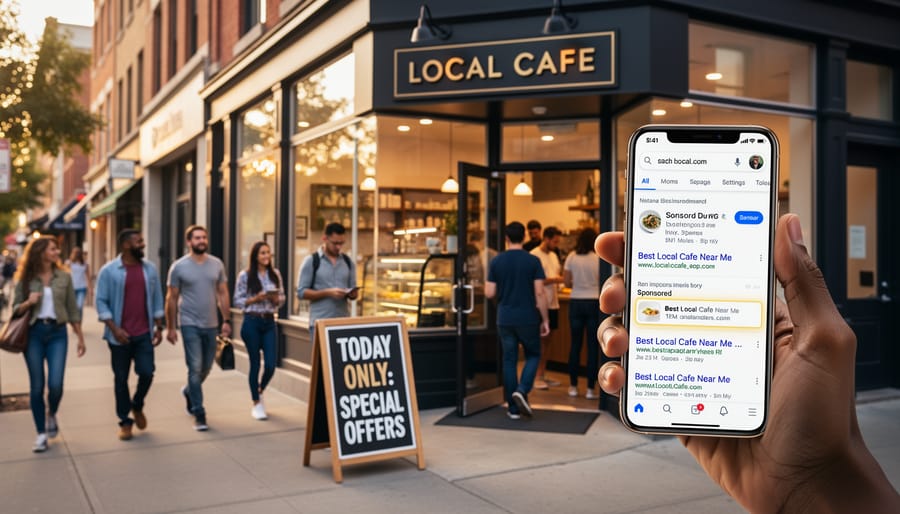
For restaurants and franchise locations, search engine marketing delivers customers actively searching for immediate solutions in their area. Location-based SEM campaigns target searches like “pizza delivery near me” or “urgent care open now,” capturing high-intent users at the exact moment they’re ready to visit or order.
The key is combining geographic targeting with mobile-optimized ads that include location extensions, call buttons, and directions. A franchise can run separate campaigns for each location, adjusting bids based on local competition and customer lifetime value. Time-of-day bid adjustments ensure ads appear when your business is open and when search volume peaks, lunch hours for restaurants, evenings for healthcare clinics. This precision turns search visibility into foot traffic and measurable local revenue.
Brand Awareness and Competitive Positioning
Search engine marketing doesn’t just capture demand, it shapes perception. When your ads consistently appear for high-value industry terms, you establish authority even among searchers not ready to convert. For legal practices, appearing above organic results for “employment lawyer” positions your firm as a market leader. Healthcare providers use SEM to claim visibility for specialized treatments their competitors may be ranking for organically but not advertising on.
Competitor keyword targeting is particularly strategic: bidding on rival brand names captures users already considering alternatives. A franchise location can bid on competing chain names to intercept that traffic with differentiated messaging. This approach works because users searching competitor names are actively comparing options. Track impression share metrics to understand how often you appear against competitors, and monitor brand search volume to gauge whether your SEM efforts are building recognition that translates into direct searches for your business name.
Time-Sensitive Promotions
Search engine marketing excels at promoting time-bound offers because campaigns can launch within hours and reach customers actively searching for what you’re selling. Unlike traditional advertising that requires weeks of lead time, SEM lets you activate ads for flash sales, holiday specials, or inventory clearances the same day you decide to run them.
Restaurants use SEM to fill slow periods with targeted promotions, advertising lunch specials to nearby office workers or promoting weekend brunch during Friday searches. Law firms activate campaigns around tax deadlines or regulatory changes when demand spikes. The ability to set exact start and end dates ensures your ad spend aligns precisely with the promotional window, and you can pause campaigns instantly if inventory sells out or capacity fills.
Measuring Search Engine Marketing Success
Tracking the right metrics transforms search engine marketing from a guessing game into a measurable investment. The key performance indicators you monitor should align directly with your business objectives, whether you’re focused on generating leads, driving sales, or increasing brand awareness.
Click-Through Rate (CTR) reveals how compelling your ads are to searchers. A CTR above 5% generally indicates your ad copy and targeting resonate with your audience, though benchmarks vary by industry. Healthcare practices often see lower CTRs than restaurants promoting limited-time offers.
Cost Per Click (CPC) and Cost Per Acquisition (CPA) measure your efficiency. While CPC tells you what you pay for each visitor, CPA shows the actual cost to acquire a customer or lead. A legal firm might accept a $50 CPA for a qualified case inquiry, whereas a franchise location might target under $15 for a customer visit.
Conversion Rate is critical, it measures the percentage of clicks that become valuable actions. This might be form submissions for healthcare providers, reservations for restaurants, or consultation requests for attorneys. Optimizing this metric often delivers better returns than simply increasing traffic.
Quality Scoreassigned by search platforms, directly impacts your ad costs and visibility. Scores of 7 or higher indicate strong alignment between keywords, ad copy, and landing pages, resulting in lower CPCs and better ad positions.
Return on Ad Spend (ROAS) provides the ultimate measure of profitability. Divide your revenue by ad spend to determine if your campaigns generate positive returns. For transparency, track this alongside impression share to understand what portion of available search traffic you’re capturing.
Regular reporting on these metrics enables data-driven adjustments that continuously improve campaign performance.
Search engine marketing stands out as one of the most controllable and measurable advertising channels available to businesses today. Unlike traditional marketing where you’re guessing at impact, SEM delivers immediate visibility paired with precise tracking, you know exactly which keywords drove which conversions, what you paid per lead, and where to adjust for better returns. This transparency makes it invaluable for business owners who need to justify every marketing dollar.
The real power of SEM lies in its flexibility. You can launch a campaign this afternoon, pause it tomorrow if needed, adjust budgets by the hour, and pivot messaging based on real-time performance data. For legal practices pursuing high-value cases, healthcare providers managing patient acquisition costs, restaurants promoting weekend specials, or franchises expanding into new territories, this agility means you’re never locked into ineffective spending. When combined with strong organic search presence, content marketing, and local optimization, SEM becomes the catalyst that accelerates results across your entire digital strategy.
How much does search engine marketing cost?
SEM costs vary widely based on industry competition and keyword difficulty, but you control the budget entirely, set daily spending limits as low as $10 or scale to thousands. Legal and healthcare sectors typically see higher per-click costs due to customer lifetime value, while restaurants and local services often find affordable opportunities in geographic targeting.
How quickly will I see results from SEM?
SEM delivers immediate visibility, your ads can appear within hours of campaign launch. However, meaningful performance data and optimization insights typically emerge after two to four weeks of active management, allowing you to refine targeting and improve conversion rates.
Should I focus on SEM or SEO?
The most effective digital marketing strategies use both. SEM provides instant traffic and tests messaging quickly, while SEO builds sustainable long-term visibility without ongoing ad costs. Start with SEM to capture demand immediately, then invest in SEO for compounding returns over time.
Many businesses attempt to manage SEM in-house but struggle with the complexity of bid management, quality score optimization, and conversion tracking setup. Professional support becomes valuable not just for launching campaigns, but for the ongoing analysis and refinement that separates mediocre returns from exceptional performance. If your business depends on consistent lead flow and you need transparent reporting that ties marketing spend directly to revenue, search engine marketing deserves a central role in your growth strategy.